TaskFlow
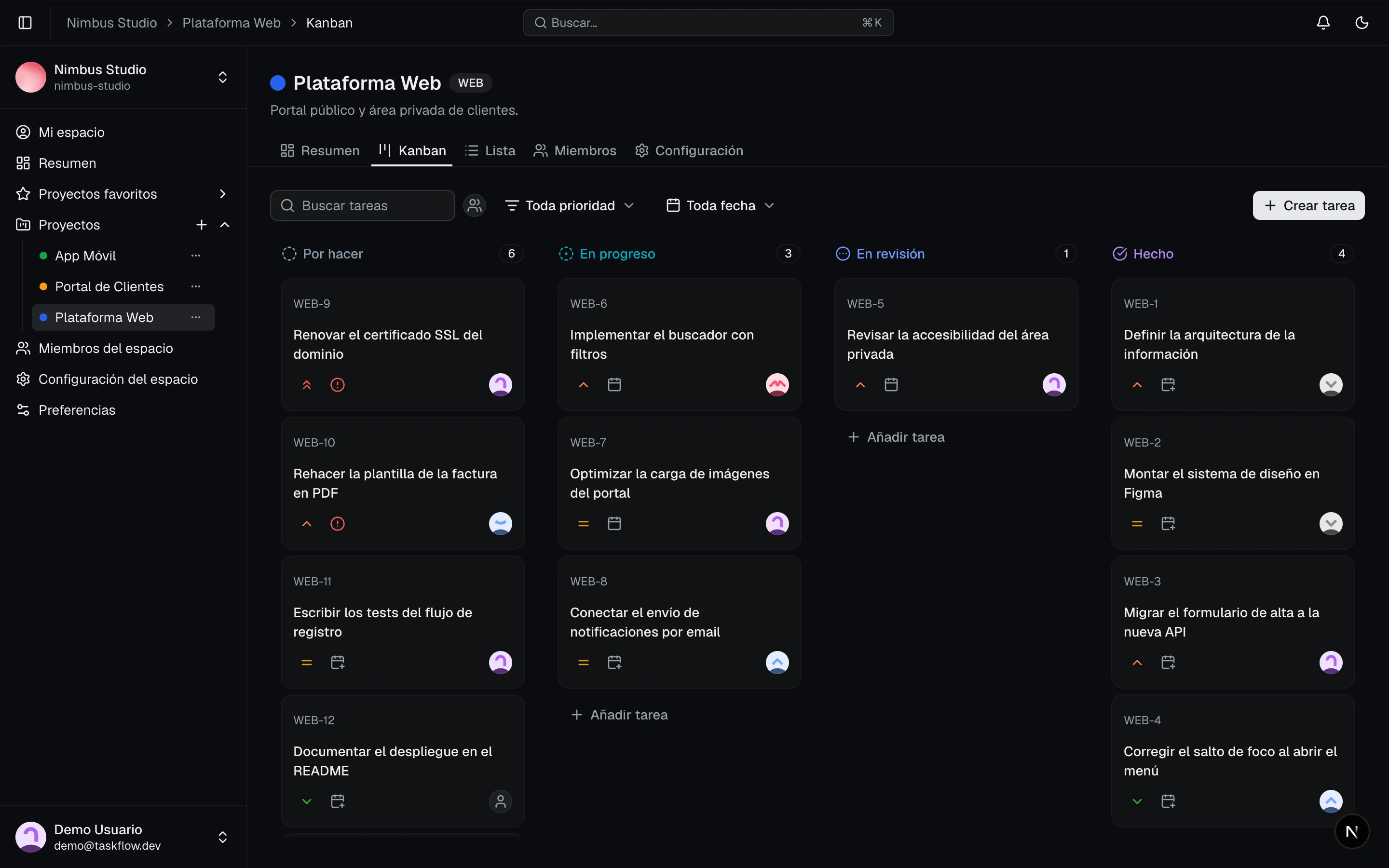
A team project and task management application, in three levels — workspaces, projects and tasks — with members and roles. Every task has a status, a priority, a due date, an assignee, comments with mentions and a history, and moves between columns by being dragged across the board.
The API lives in its own repository: Express 5 and TypeScript in layers (route → controller → service → repository), Prisma on top of PostgreSQL, Zod validating everything that comes in, and sessions with access and refresh JWTs in httpOnly cookies. Its 378 tests are integration tests: they hit the real API against its own Postgres in Docker.
The history and the notifications are not solved separately: they come out of a single event table, written in the same transaction as the change that caused it, so the log cannot claim something that later rolled back. Avatars never go through the API: the browser compresses the image, asks for a signed URL and uploads the file straight to the bucket — Cloudflare R2 in production, MinIO locally — and the backend only confirms afterwards that the object is there. And card ordering uses lexorank, the way Jira does it, because a numeric field runs out of room as you reorder.
The client is Next.js 16 with the App Router and React 19: React Query for server state and optimistic dragging, socket.io for real time, and filters, search and pagination in the URL through nuqs, so any view can be shared as a link. It is my largest project so far, and the first where I wrote the decisions down as I made them.
Stack
Next.js · TypeScript · Tailwind CSS · Express · Prisma · PostgreSQL · Socket.IO · Docker
Live demo in progressClient sourceAPI source
Screenshots (06)
A workspace summary: the counters, the projects, my own queue of tasks and the activity log.
A counter only counts reachable work — active projects you belong to, and the tasks inside them — because a number larger than the list right below it reads as a bug, not as extra information. And the feed cuts one level below its scope: it reaches the projects, never each task's detail, because a single busy project would drown out the rest.
A project summary, with its tasks by status, by priority and by due date.
Charts live only here: it is the one scope with enough homogeneous data for a chart to mean anything, so the workspace summary deliberately has none. Due dates go into buckets — overdue, this week, scheduled, no date — and "overdue" means its day has already passed in the user's own time zone: what is due today does not count until tomorrow.
The task list, with its filters for status, priority, date, archived and favourites.
Filters, search, sorting, page and the open tab live in the URL through nuqs, never in useState: a link to "the archived tasks" has to open right there and survive a refresh.
Task detail: its fields, the comment thread with mentions, and the activity.
The modal is mounted once at the root and addressed through the URL, so it opens the same way from the list, the board or the search, without losing the screen behind it. Mentions go by username and the comment stores the id alongside it: the id is the only immutable part, and the username keeps the text readable if that person is no longer on the project. Editing only notifies whoever the edit mentions for the first time, because fixing a typo should not ring anyone's bell.
A workspace's members and their roles, with pending and inactive ones behind a filter of their own.
Nobody is deleted: every removal is a soft one and each has its inverse verb, but it wipes the role, so coming back asks which role to return with instead of storing a previous one that goes stale. That filter is only drawn for whoever can undo the removal, because showing rows that lead nowhere is a dead end, and when a row has a single action it is a button: a one-item menu makes you open it to find out there was nothing to choose.
Global search, opened with ⌘K from any screen.
It crosses workspaces, projects and tasks in a single request and resolves no slug, so the only thing separating yours from everyone else's is the same visibility predicate the summaries use: what you cannot open from any screen cannot surface here either. It also searches by the task's label, WEB-12, which exists in no column: it has to be split into the project key and the number.